RESEARCH · ATTENTION
ADHD and Attention in Shibari: Data and Hypotheses
What research can, and cannot, tell us about attention, sensory experience, and the two sides of the rope.
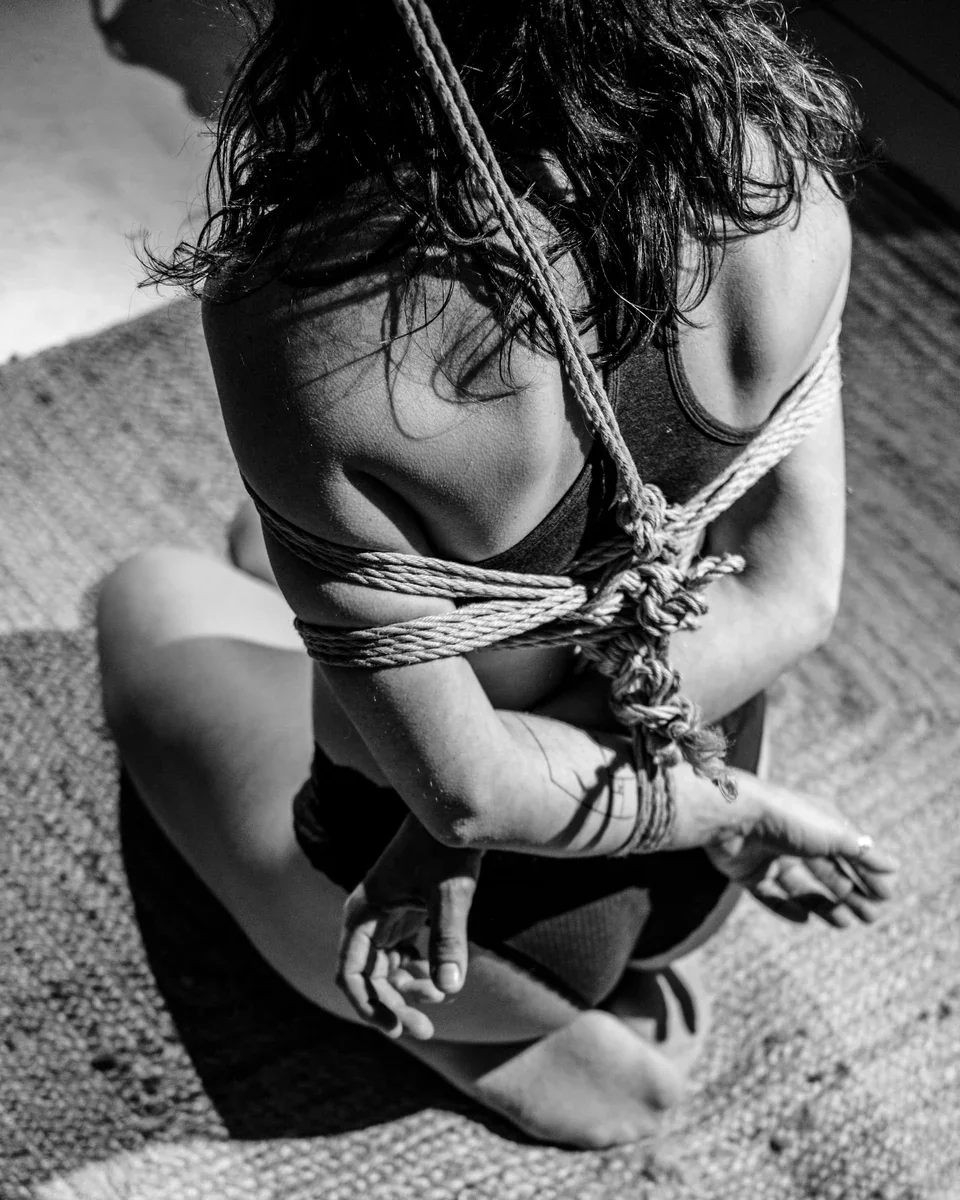
Why does a complex task sometimes scatter attention, and sometimes seem to pull it together?
In shibari, the question comes up almost by itself. Rope. Body. Tension. Safety. The other person’s response. The next movement. What you planned to do, and what is already happening now, which may require something completely different.
When I started thinking about this, I got to attention fairly quickly. Then to ADHD. A few steps later I found myself in a familiar place: the point where something you love doing starts asking for a beautiful theory to explain it. That is usually a good moment to slow down.
This is not an attempt to explain ADHD through shibari, and it is not medical advice. I am interested in something narrower, and probably more useful: where my observations as a practitioner end, where the evidence begins, and what can honestly be said in the space between them.
There is another boundary worth making explicit. I only know one side of this experience from the inside: the side that leads. I can ask about the other side, listen, compare, notice patterns. What I cannot reasonably do is tell someone what they were “really” feeling because it happens to fit my theory. Still, it was exactly the difference between those two sides that made me curious. I went looking for evidence. I found several interesting clues, and no neat explanation.
When Many Tasks Become One
Tying involves a constant stream of small decisions. Where the rope goes next. What happens to the body. How tension changes. How the person responds. Whether to continue with what you had in mind a minute ago, or drop the plan because the situation has already changed.
For me, though, these do not feel like twenty separate tasks. They are connected. One movement produces a response, the response changes the next movement, and that movement changes something else. Sometimes the whole sequence unfolds in a few seconds. You are about to continue in one direction, the tension shifts, the torso turns differently, breathing changes, the face changes, and suddenly the next part needs to be rebuilt. Not because the plan was wrong. The situation is simply no longer the same.
That is what made me wonder whether this kind of structure can help attention settle. Especially for someone who finds sustained attention difficult in other contexts.
There are a few useful clues in ADHD research. In two survey samples, adults with more pronounced ADHD symptoms reported hyperfocus more often: prolonged, intense absorption in an activity. The important word is reported. This tells us something about people’s experience, not how to switch hyperfocus on, why it starts, or how much control a person has over it.
Another small study looked at mind wandering under different levels of cognitive load. In adults with ADHD, higher working-memory load was associated with less mind wandering. But the same pattern did not appear in a sustained-attention task. So the easy story, “give the brain more to do and it will focus better,” does not really survive contact with the data. And, obviously, there were no ropes involved.
Still, this brings me straight back to something I recognise in practice. During a session, I often do not feel as if I am switching between a dozen independent tasks. They collapse into a single process: hand, rope, body, response, next movement. Not a checklist, but one continuous structure. That is only an observation, but it gives us a more precise question: can many tightly connected actions be experienced as one task, making it easier for attention to stay engaged?
There is a second question I care about even more. If attention becomes deeply absorbed in the process, is there still enough flexibility to shift from the task to the person when needed? Because being absorbed is not the same thing as being attentive to someone.
What Happens at the Other End?
Now take the other side of the rope.
Some decisions really can be handed over. The receiving person may not need to decide where the rope goes next, what shape is being built, or what the next few movements will be. Sometimes even the pace is largely held by the person leading. It is tempting to turn that into a neat picture: one person suddenly gets twenty tasks, while nineteen are taken away from the other.
Neat, yes. Probably too neat.
Being on the receiving side is also work. Noticing pressure, tension, position, discomfort, pleasure, fatigue. Realising that something has changed. Communicating it. Asking for an adjustment. Deciding whether you want to continue. That side still has its own decisions and its own demands on attention. The person leading may simply not be able to see most of them.
So the question that interests me is not “who has less to do?” It is this: what becomes easier on each side, and what demands more attention instead?
Body, Sensation, and ADHD
This is where another attractive explanation tends to appear. If ADHD involves a need for stimulation, perhaps strong bodily input, pressure, restriction, or intense sensation helps a person focus or “come back into the body.”
The evidence is much less tidy.
A meta-analysis of 30 studies did find differences in sensory processing between people with ADHD and control groups. But those differences did not amount to a universal preference for stronger stimulation. The literature includes increased sensitivity, sensory avoidance, sensory seeking, and reduced registration of sensory input. In the adult subgroup, there was no convincing difference specifically in sensory seeking.
For practice, that leads to a fairly simple conclusion: a diagnosis does not tell you how a particular person will respond to rope. Pressure may feel grounding to one person, overwhelming to another, and unremarkable to someone else. This also matches what I see without needing a paper to tell me. The same action can produce completely different responses in two people. Even with the same person, the response today may not be the response next week.
That is also why I have become more cautious about phrases like “coming back into the body.” They sound good, but what exactly do they mean? Noticing sensations more clearly? Feeling them more intensely? Distinguishing them more accurately? Understanding internal states better? These are not the same thing.
Research on interoception, the perception of internal physiological signals, also suggests that there may be differences associated with ADHD. A systematic review identified 17 relevant studies, but direct comparisons between people with and without ADHD were limited, sample sizes were often small, and the methods varied considerably. None of this allows us to conclude that rope pressure improves interoception.
And again, this is where I would rather resist the urge to explain too much. If someone says after a session, “I could suddenly feel my body much more clearly,” that statement already matters. It is a description of experience. It does not need to be immediately upgraded into a claim about their nervous system. Sometimes the first useful thing is simply to listen.
Two Roles, Two Different Processes?
The most direct clue I found about role differences came not from ADHD research, but from a small BDSM study. Fourteen experienced participants were randomly assigned to top and bottom roles. Researchers looked at flow-related measures and performance on a cognitive task after the interaction. The pattern of changes differed between the two roles.
For my hypothesis, that is very tempting. But the limitations are obvious: fourteen participants, BDSM broadly rather than shibari specifically, and no ADHD comparison. We are nowhere near “this explains what happens in rope.”
What it does give us is a legitimate question: could the two sides of the same session place genuinely different demands on attention?
That question makes sense to me from my own end of the rope. I can be deeply occupied with the structure of an action while constantly receiving feedback from the person in front of me. At the same time, an entirely different kind of work may be happening on the other side, much of it invisible to me. We are inside the same process, but not necessarily inside the same experience.
For Now, It Is a Working Hypothesis
My working hypothesis is fairly modest. On the leading side, attention may organise itself around the task, continuous feedback, and the need to respond to what is happening in real time. On the receiving side, attention may be distributed differently, across sensation, personal decisions, anticipation, and contact with the partner.
Do these processes actually differ in a consistent way? What role, if any, does ADHD play? Is there anything specifically rope-related here? I do not know. Trust may matter more. Interest may matter more. Experience, the specific person, the relationship between two people, or some combination of all of these may matter more.
What I did not find in the literature was any good reason to say that shibari treats ADHD. And that is fine.
I am much more interested in a different question: what happens to attention when two people are connected by the same rope, while doing very different kinds of work inside the same interaction?
From my side, I can shape the action and see the response. What the other person actually experiences inside that action is still something I have to ask them about.
Research and Sources
Hupfeld K.E., Abagis T.R., Shah P. Living “in the zone”: hyperfocus in adult ADHD. Attention Deficit and Hyperactivity Disorders, 2019, 11(2), 191–208.
DOI · PubMed
Bozhilova N. et al. Context Regulation of Mind Wandering in ADHD. Journal of Attention Disorders, 2021, 25(14), 2014–2027.
DOI · PubMed
Jurek L. et al. Sensory Processing in Individuals With Attention-Deficit/Hyperactivity Disorder Compared With Control Populations: A Systematic Review and Meta-Analysis. Journal of the American Academy of Child & Adolescent Psychiatry, 2025, 64(10), 1132–1147.
DOI · PubMed
Bruton A.M. et al. Diminished Interoceptive Accuracy in Attention-Deficit/Hyperactivity Disorder: A Systematic Review. Psychophysiology, 2025, 62(2), e14750.
DOI · PubMed
Ambler J.K. et al. Consensual BDSM Facilitates Role-Specific Altered States of Consciousness: A Preliminary Study. Psychology of Consciousness: Theory, Research, and Practice, 2017, 4(1), 75–91.
DOI
No separate PubMed record was found for this publication.