01 / 04
2026 · Best Studio · Bat Yam, Israel
The Shape of a Break
Shibari × kintsugi · body, rope, vessel, trace
Project details
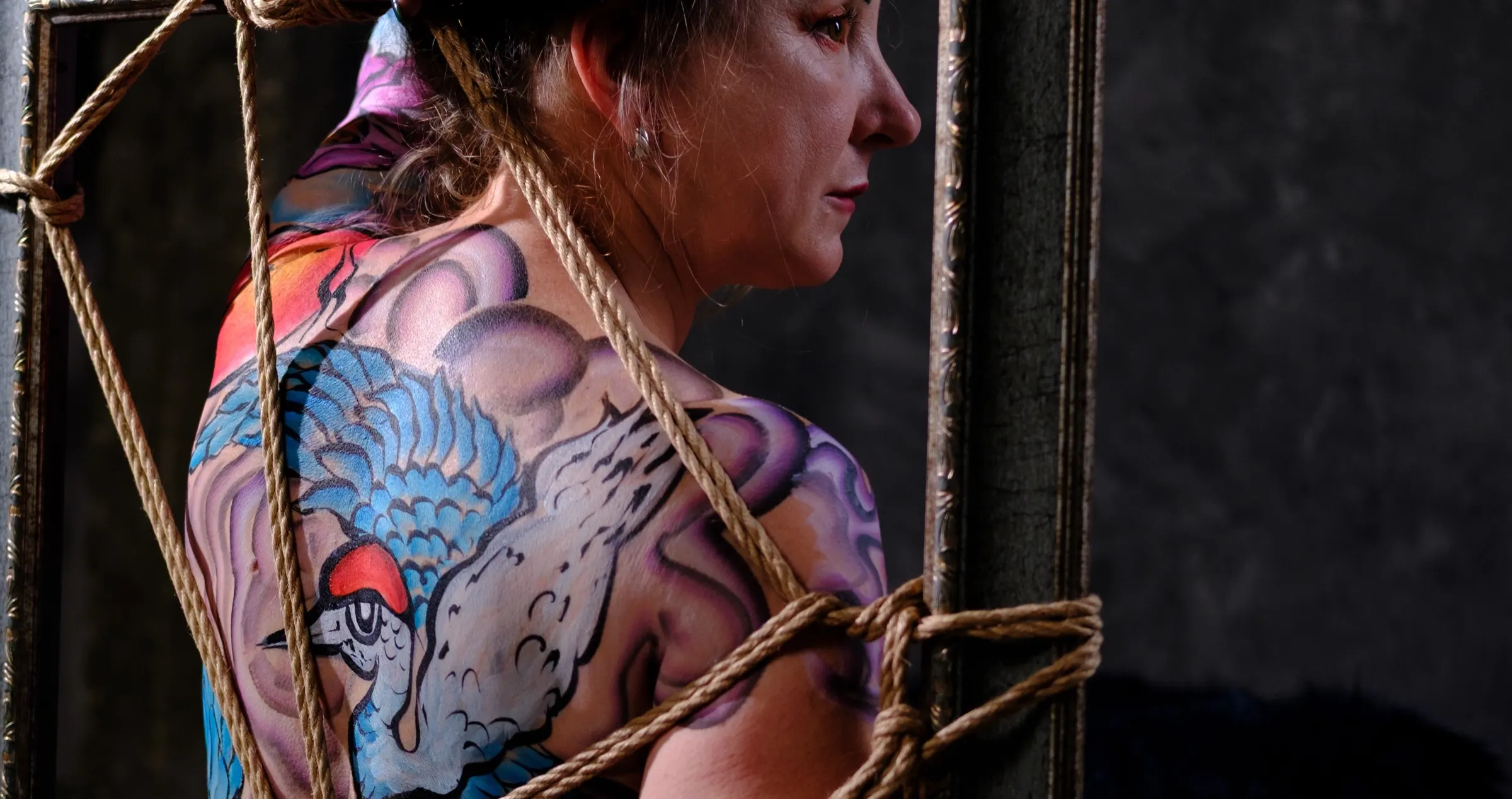
We found the vessel after someone had thrown it away. We painted it together, following the visual language of kintsugi; then we brought it into the studio with Tiana. In Japanese kintsugi, broken ceramics are joined with urushi lacquer, and the repair may be finished with powdered gold. Our vessel is a painted interpretation, not an urushi repair. I wanted to see what might happen when its visible lines met rope, body, and a person who could answer the image with her own movement.
Project details
- Year
- 2026
- Location
- Best Studio · Bat Yam, Israel
- Medium
- Photography · Shibari · Body art · Video
There is an obvious resemblance: a gold line on a vessel, a rope line across a body. It was the least interesting part for me. In kintsugi, the break has already happened. The person repairing the vessel has to work with the direction of that break. A seam can hold the pieces together and remain visible. The object does not return to the exact state it was in before.
With shibari, the line begins in the present. I place a rope, feel its tension, change its direction. But the body is not a surface waiting for my drawing. Tiana shifts her weight, breathes, turns her head, looks back. Sometimes a small movement changes the whole construction. The line we see is made between us; it is never mine alone.
That difference matters. A ceramic vessel can be repaired. A person is not a broken object to be put back together by somebody else. I am not asking rope to fix anyone. What interests me is how a line can reveal a relationship: where weight is carried, where there is space, where one gesture changes another. For a while the rope holds a shape. Then it comes off.
The vessel stays. The body paint lasts a few hours. Rope leaves a short-lived impression on skin. The photograph keeps light from a moment that is already gone. These are four different kinds of time in the same frame. Perhaps this is where I feel the connection most strongly: both practices make a join or a trace visible, but they do not make it permanent in the same way. The gold-coloured mark points to an earlier break; the rope shows a tension that exists now.
Diana brought the idea of a visible seam onto Tiana’s skin. I responded with rope and light. Tiana was not a still centre around which we arranged our ideas. Her gaze, the way she held the vessel, a change in her shoulders or hands made us reconsider the next frame. Paint affected rope; rope affected posture; posture affected the photograph. We kept listening to what was actually there.
There are places in these photographs where the forms almost meet. The curve of the vessel echoes the body. A painted line travels across skin and seems to continue on ceramic. Then it stops. I like that small distance. In Japanese aesthetics, ma can name the interval that gives things room to relate. I think about it here as the space between hand and face, vessel and body, rope and skin. The space is doing work too.
One frame is almost dark. You can still find the rope, an edge of the vessel, part of Tiana’s face. The rest takes longer to see. That partial view brings me close to what yūgen suggests to me: a depth that an image can approach without showing all of it. I use the word as a way of thinking about our looking, not as a claim that this project belongs to a Japanese tradition.
At the end we lower the rope and the painted lines begin their own slow disappearance. The vessel remains in the room. Tiana remains herself, beyond the shape we made together. I look at the last photograph and see less of an answer than a brief meeting of different histories... and the space that stays between them.
Credits
Concept, shibari & photography
Roman / Ded Mazai
Body art
Diana Yanvareva
Model
Tiana Nephila
Video
@olesya_vision._Copyright
© 2026 MAZAI.art
 Body Touches Body